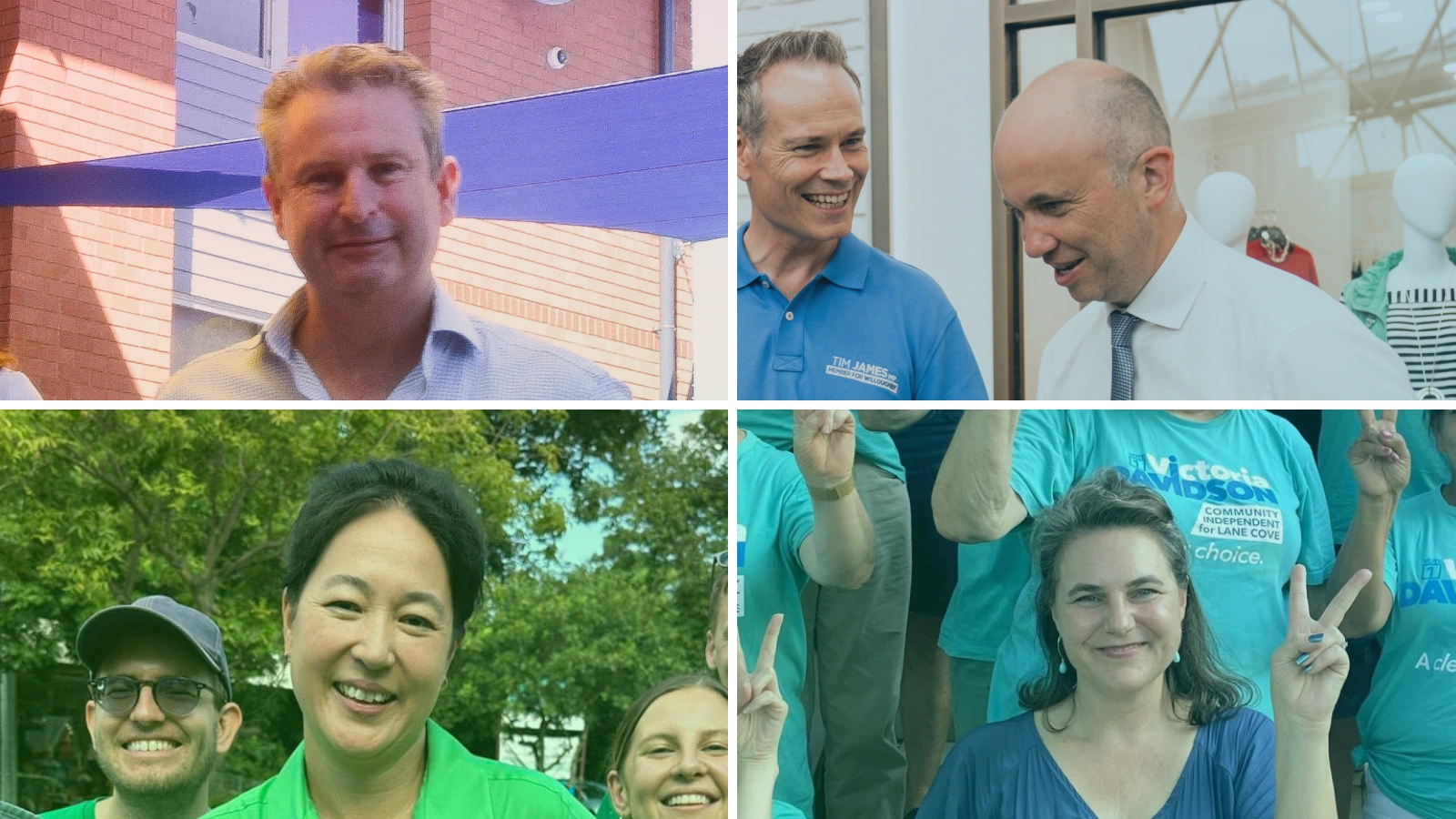
From top left: Greg Warren, Matt Kean, Jenny Leong, Victoria Davidson
Liberal Treasurer Matt Kean, Labor Shadow Minister Greg Warren, Greens MP Jenny Leong and Lane Cove independent candidate Victoria Davidson answered our questions on where they stand on the major issues.
Our full conversations are available at these links: Greg Warren, Jenny Leong and Victoria Davidson. Matt Kean provided written responses.
Climate crisis
Matt Kean: In 2016, NSW was one of the first jurisdictions in the world to commit to net zero emissions by 2050 just as the Paris Agreement was coming into force.
Since then, we’ve set targets of 50% emissions reduction by 2030 and 70% by 2035 and detailed modelling confirms we’re on track to meet those.
Our Electricity Infrastructure Roadmap is the nation’s most comprehensive renewable energy policy, a plan to replace our retiring coal-fired power stations with five renewable energy zones across the state that will deliver some of the cheapest, cleanest and most reliable electricity anywhere in the world.
Our Electric Vehicle Strategy, recognised by the Electric Vehicle Council as “Australia’s best electric vehicle policy”, sets out a pathway to propel electric vehicles to 52% of new car sales in NSW by 2030–31.
In the next term of Government, the Liberals and Nationals will focus on accelerating the rollout of the Roadmap with our newly announced $1.5 billion Clean Energy Superpower Fund. The Fund will help us bring forward the delivery of transmission infrastructure, renewable energy storage like pumped hydro and grid batteries as well as local energy upgrades like community batteries.
Greg Warren: We want to have a more progressive and proactive approach to climate change which I think is directly relatable to energy prices. Broadly, the privatisation of our energy assets is something that I think we’re all feeling the pinch now from.
We’ve announced a whole raft of things from rebates and then financial support, and the NSW Energy Security Corporation to bring all of that together.
How do we invest into the new technologies of the future? What can we do to restrict or bring down energy prices for local families and businesses whilst in the interim providing them with financial support is something so important?
I think the corporation itself and why it’s such a good thing is because we hear a lot of conversations and we all believe in it and we all say ‘yeah that’s great’, but how do we do it?
I believe our establishment of that corporation will provide us with the mechanisms to do that.
Jenny Leong: You do not have to look very far into our communities to see the devastating impacts of both the climate emergency and the housing crisis.
In the communities in the Northern Rivers, they saw devastating floods as a result of extreme weather events caused by climate change. And at the same time now, they are seeing a housing crisis because of complete failure for the government to step in and deliver the support that is needed.
The Greens want to see an end to coal and gas in New South Wales by 2030 and part of our expectations on the NSW Labor Party is to get to that point. We need to see a commitment out of them that they will not approve any new coal or gas mines in the new parliament.
The climate emergency is here and it is real and we know that the big polluters are profiting out of causing that climate emergency. We need to step up and stop it or we are going to see a real challenge for the future generations, but also for the current generation that is currently suffering as a result of the failure to stand up to the corporate coal and gas giants.
Victoria Davidson: We need to legislate emissions reductions targets, that is the first thing we need to do, and we need to have accountability and transparency in the reporting of those. It is very easy to set some targets, but you have to make those meaningful.
We need a whole-of-government approach to climate change. Every decision that government makes has to take climate change into account. Planning is a really big part of this and public transport is a huge part of this.
Efficient and green public transport is a very important part of us meeting our emissions reductions target and becoming a green economy. We have got to address the hard-to-abate sectors and we have to look at regions that are right now in fossil-fuel industries and help them transition.
This is about a fair and equitable transition for them and for the whole state. No one should be left doing heavy lifting here. What concerns me is with the lack of planning that we have and a lack of strategic overview that things get left almost to the last minute.
We can see this coming. We know this is coming and these coal-dependent regions know this is coming. Of course, they are scared because what are they going to have employ them?
We cannot bury our heads in the sand. We have to take a proactive approach and help people along the way.
Keep reading...